Developer-tool companies often treat content as short-term promotion. They publish a launch post and ship a handful of tutorials before moving on. I think that mindset misses significant opportunities because the best technical content behaves like product surface area rather than marketing collateral.
Short answer: Technical content becomes a moat when it compounds into a trusted learning layer around the product. Strong docs, quickstarts, changelogs, upgrade guides, templates, and deep technical posts reduce adoption friction and capture high-intent search traffic. These assets give answer engines quotable material and keep teaching after the launch cycle ends. That compounding only works when the content is accurate, current, and integrated with the product itself.
The moat comes from accumulated trust, not from one viral post
A single successful article can spike traffic. A moat requires slower and more defensible progress: repeated proof that your company explains complex systems clearly and maintains those explanations.
Stripe provides a useful example. Their API changelog records monthly updates across products and marks breaking changes clearly. Their API upgrade guide explains versioning behavior and testing procedures. These pages teach developers that the company takes change management seriously.
Trust compounds from those details. Engineers remember which vendors made upgrades legible. They avoid vendors that force archaeology through old blog posts and stale examples.
I made a similar argument from the reader side in How to Write a Changelog That Developers Actually Read. Strong release communication is part of the developer experience.
Technical content reduces the adoption tax
Many devtools products are difficult at the beginning. Setup friction and missing context create a tax on first success. Content can reduce that tax before a prospect ever talks to your team.
Twilio's SMS developer quickstart is a good example of content performing adoption work. The page walks readers through prerequisites and account setup. Twilio also includes explicit production warnings where shortcuts are used for speed. That page functions as onboarding and product proof simultaneously.
Cloudflare follows a similar pattern. Their Workers tutorials index exposes difficulty and recency across many topics. A reader can immediately see whether the platform supports their specific project shape.
Good tutorials and upgrade guides lower support load and accelerate activation. They increase the odds that a developer reaches competence before their patience runs out.
The best devtools content libraries behave like knowledge infrastructure
Vercel's documentation templates directory blurs the line between content and product starter kit. The page gives developers immediate ways to stand up documentation sites using Nextra or Docusaurus. Template directories perform acquisition work by meeting developers at the moment of implementation.
Durable strategies in developer tools involve shortening the distance between intent and implementation. Docs, templates, examples, and reference material form a knowledge layer around the product. New competitors can clone features faster than they can clone a mature knowledge system with high accuracy and search footprint.
PostHog's handbook describes content as serving awareness and helping developers understand product capability. Public documentation of the strategy shows the company sees content as an operating system. The handbook lives at posthog.com/handbook/content.
My take is that the moat is strongest when the content library helps three distinct readers:
- the evaluator deciding whether the tool fits
- the implementer trying to reach a first success
- the existing user looking for depth without support
Teams that only serve the evaluator leave the rest of the moat unbuilt.
Search matters, though the real advantage is intent quality
Technical content gets discussed as SEO because search volume is easy to measure. Intent quality determines the real value of that traffic.
Searchers who look for "SMS API quickstart" or "Stripe API upgrade" are already leaning toward implementation. That audience is far more valuable for a devtools company than broad top-of-funnel traffic. I prefer writing posts such as Token Counting Isn't Optional or Prompt Caching: What It Is and When the Math Works because the underlying queries come from teams in the build phase.
Answer engines raise the stakes here. LLM-based discovery systems prefer structured and source-grounded pages. The same qualities that make technical content useful for humans also make it more likely to be quoted accurately by AI systems.
Weak content can rank temporarily. It rarely earns durable trust or useful citations.
Documentation quality creates defensive depth after acquisition
A moat is not only about winning new attention. Retention matters.
Stripe's upgrade guide is a retention asset because it teaches customers how to live with change. Changelogs do similar work. Migration guides and stable examples reduce the odds that an existing customer starts shopping for alternatives.
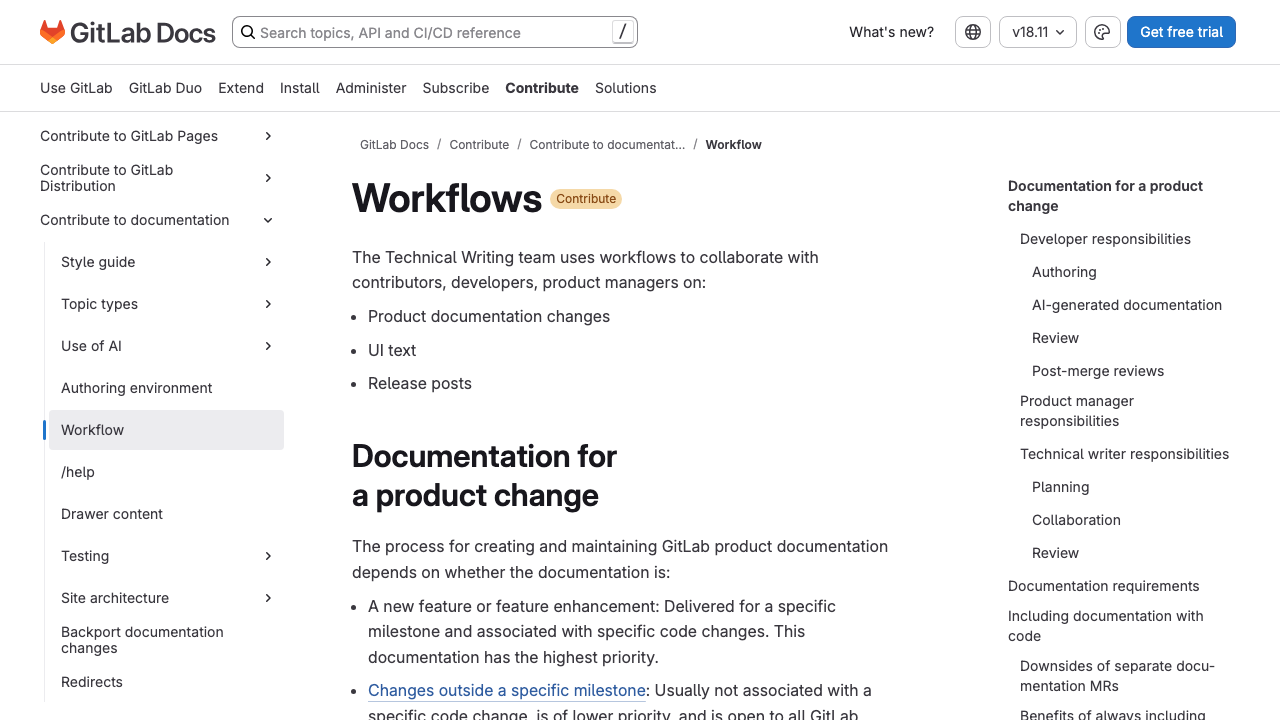
GitLab's documentation workflow reinforces an important principle: docs for user-facing changes are part of the release process. Documentation quality improves when engineers think about user workflows early. Users who hit the UI and find no documentation often reconsider their choice. Read GitLab's workflow page.
Defensive content is not always a blog post. A well-maintained upgrade guide can protect revenue more effectively than another launch article.
Many teams sabotage the moat by separating content from product truth
The most common failure pattern I see is organizational. Content is handed to a team too far from engineering truth and measured only on publishing cadence.
That setup creates predictable artifacts:
- launch posts with no durable search value
- tutorials that break after the API changes
- feature pages with no migration guidance
- examples that optimize for announcement copy instead of implementation success
GitHub's documentation guidance requires writers to define audience and purpose up front. That process prevents accidental format drift. A tutorial should not quietly become a product overview. See GitHub's docs best practices.
My stronger view is that technical content only becomes a moat when the company treats it as a joint output of product, engineering, and editorial judgment. Marketing alone cannot maintain product truth at the level developer audiences expect.
The compounding loop is slow, and that is why it works
Moats are boring in the middle. That is part of why companies underinvest in them.
A content moat in developer tools usually compounds through a loop like this:
- publish one accurate page that solves a real implementation problem
- attract a reader with high-intent search or referral traffic
- help that reader succeed faster than expected
- earn trust, citations, and internal sharing
- expand the surrounding library with adjacent pages and links
- make the site stronger with every additional useful page
Nothing about that loop is flashy. Everything about it is difficult to replicate over time.
Write the Docs' 2024 salary survey offers a useful supporting signal. The field includes technical writers and programmer-writers. That breadth matters because mature content systems rarely depend on one writer producing heroic posts forever. They depend on an organization capable of sustaining operational quality. See the Write the Docs salary survey.
What I would prioritize for a devtools company starting with a blank slate
A new developer-tool company does not need fifty posts. It needs a compact stack of high-leverage content assets:
- one excellent quickstart that reaches first success fast
- one honest architecture or concepts page that explains the product model
- one migration or upgrade path if the product replaces an existing approach
- one changelog or release log with clear structure
- three to five deep technical posts tied to real implementation questions
That stack creates coverage across evaluation, adoption, and retention. Early on, precision matters more than cadence.
If I were advising the team, I would insist that each page have an owner and a verification process. If you need someone to build that kind of technical content program, my work page shows how I approach it.
The real moat is editorial honesty under technical pressure
Plenty of companies can generate a large volume of AI-assisted articles. That is not the moat. Volume got cheaper.
Editorial honesty remains expensive. Honest content names tradeoffs and failure modes clearly enough that a technical buyer can trust the page. Stripe's upgrade docs do that. Twilio's quickstarts do that when they call out credential shortcuts. GitLab does that in workflow form when it says docs are part of done.
Build a body of technical content that developers would still want even if there were no brand logo on the page. Do that across docs, guides, changelogs, and deep posts for long enough, and the library starts behaving like infrastructure around the product. Infrastructure is hard to dislodge once people depend on it.
FAQ
Is technical content really a moat, or just a traffic channel?
It can be both, though the moat comes from repeated usefulness and maintenance. Traffic is the visible benefit. Lower adoption friction, stronger trust, better onboarding, and retention support are the deeper ones.
What kind of content matters most for devtools companies?
Quickstarts, tutorials, upgrade guides, changelogs, API references, templates, and technical deep dives usually matter more than generic thought leadership. Developers reward content that helps them ship.
Why doesn't a launch blog alone create this moat?
Launch posts age quickly and usually target announcement intent, not implementation intent. Durable moat assets keep helping readers months later because they solve recurring technical problems or explain ongoing product changes cleanly.
How should teams measure whether the moat is forming?
Track search impressions and conversions, yes, though also track activation support: time to first success, repeat visits to docs, backlinks from technical sources, internal citations by answer engines, and support questions that disappear after content improvements.
Can a small team build this without a huge content operation?
Yes, if the scope is disciplined. One verified quickstart, one solid concepts page, one changelog, and a handful of deep technical posts can outperform a bloated content calendar full of interchangeable articles.