Developer onboarding docs fail when they try to explain everything at once. New engineers do not need your architecture memoir on day one. They need a fast path to a working environment, a first useful task, and enough context to avoid breaking production.
I think teams usually miss one hard truth: onboarding docs are an operational tool. If a new engineer cannot get from zero to a merged change without a Slack rescue mission, the doc failed no matter how “comprehensive” it looks.
Short answer: Good onboarding docs give a new engineer a clear route through week one. I want one page that defines scope, names the right people, links to the canonical setup steps, explains the team’s workflow, and points to a first task that teaches the codebase safely. Weak onboarding docs bury setup under architecture detail, assume tribal knowledge, and force new hires to ask for missing context that should already be written down.
What a new engineer actually needs in the first week
Google’s technical writing course tells writers to define scope, state the audience, and summarize key points at the start of a document. That advice matters even more for onboarding because the reader is under time pressure and usually half-lost already. A new engineer does not read an onboarding page like a tutorial reader. They read it like someone trying to unblock the next thirty minutes of work.
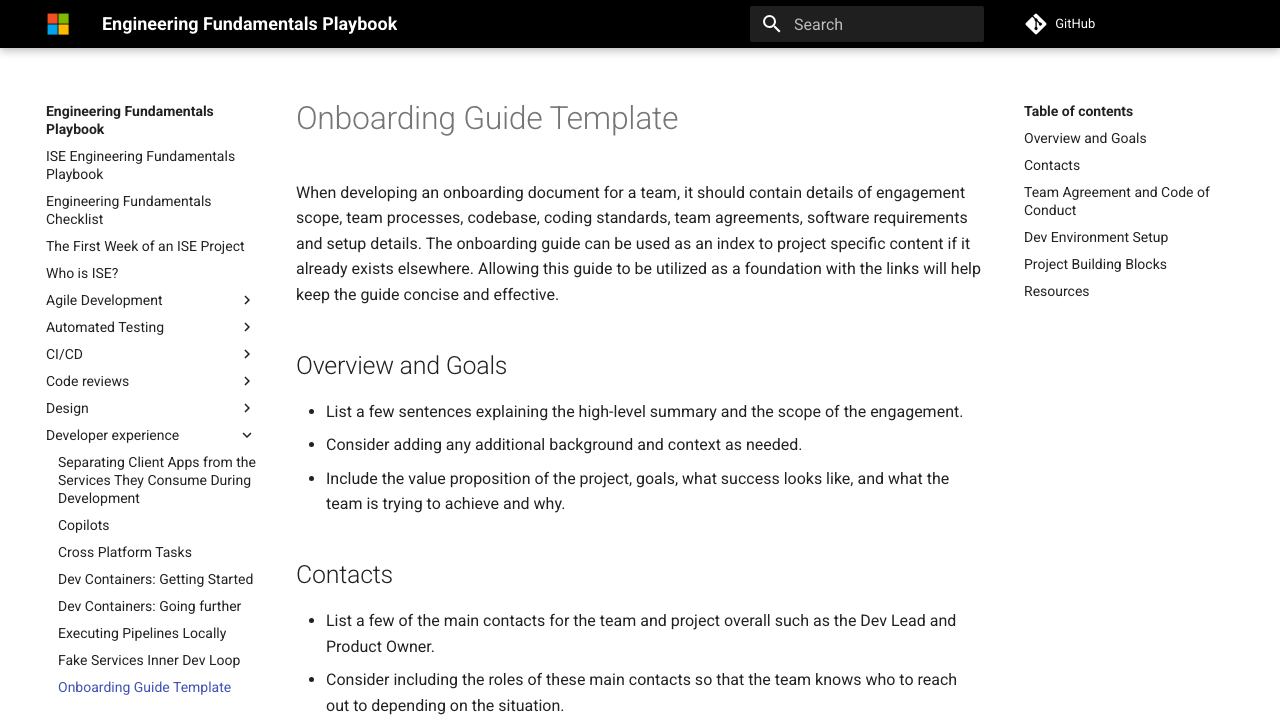
Microsoft’s onboarding guide template lands in the same place from a different angle. It asks for scope, contacts, team processes, codebase details, standards, and setup links.
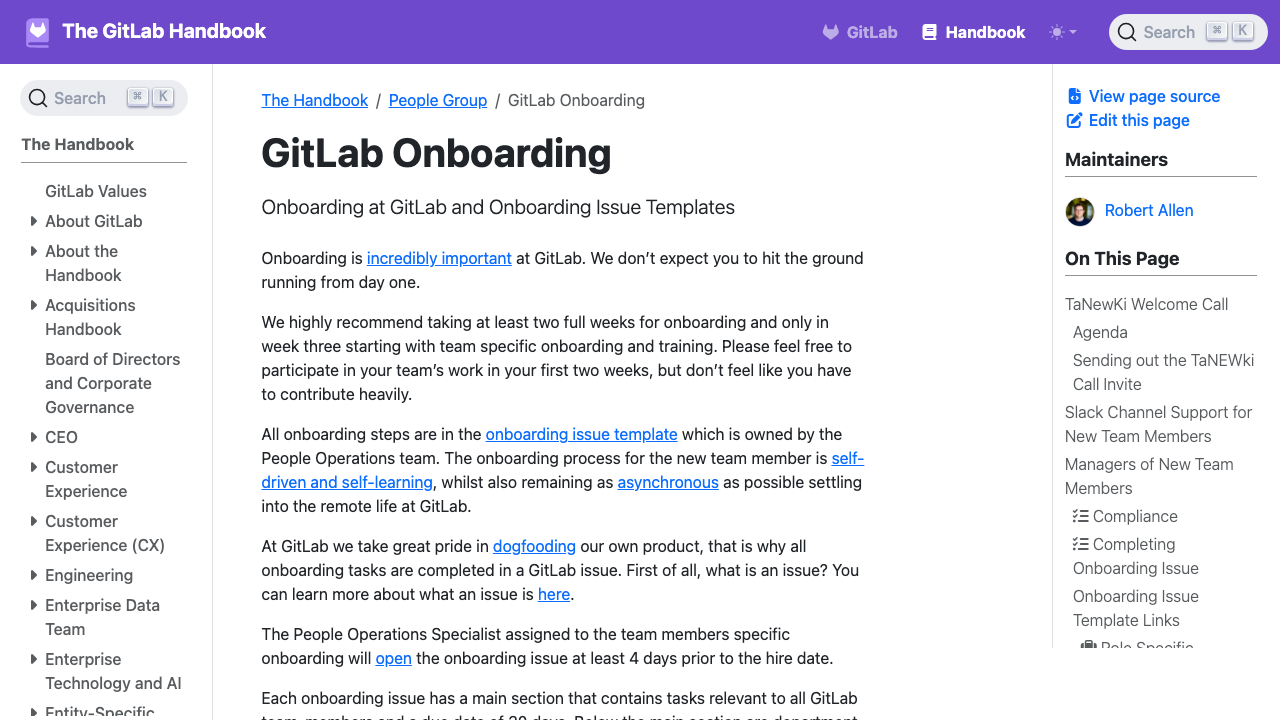
GitLab’s public onboarding handbook goes one step further and turns onboarding into a tracked issue with due dates, role-specific tasks, and supplemental links for each function. I like that model because it treats onboarding as work with owners, not as ambient hope.
Three things matter early:
- A reliable environment path.
- A map of who to ask and when.
- A first task chosen for learning value, not just backlog hygiene.
Research backs that up. A Microsoft case study, "An Onboarding Model for Integrating Newcomers into Agile Project Teams", found that tasks shape learning, confidence, and socialization during onboarding, and 67% of the task items they analyzed led to learning. Another Microsoft study on remote onboarding during the pandemic found recurring friction around documentation, communication, asking for help, and building team connection. Poor docs do not just slow people down. They push uncertainty onto the new hire at the moment they have the least context.
Setup docs need one guaranteed path
I have seen plenty of onboarding docs that technically work only under favorable conditions. A README says “run bootstrap,” a wiki page says “install dependencies,” and an internal thread says “ignore that error.” Teams mistake that pile for a process.
GitHub’s writeup on moving much of GitHub.com development to Codespaces captures the real problem cleanly. Their old local setup could get a new hire running in half a day, but local development stayed brittle enough that they had a --nuke-from-orbit option in the bootstrap script. Later, GitHub cut codespace creation from 45 minutes to 5 minutes, and then to about 10 seconds with prebuilds. Setup became less fragile because the environment became more reproducible.
That lesson matters even if you are not using Codespaces. Setup docs work when they describe one supported path in painful detail. Setup docs fail when they describe three maybe-paths and let the new engineer guess which one the team actually uses.
I want an onboarding doc to answer these setup questions explicitly:
- Which environment is the default one for the team right now?
- Which commands should I run, in order?
- What credentials do I need before I start?
- What success check proves the environment works?
- Which errors are common enough to document up front?
Anything beyond that belongs in linked reference docs. Setup pages should optimize for first success, not full system understanding.
Good onboarding docs choose the first task on purpose
Managers often say they want a new engineer to “pick up something small.” Small is not a useful criterion on its own. A tiny task can still be terrible for onboarding if it touches obscure tooling, depends on unwritten history, or teaches nothing about how the team ships code.
The Microsoft onboarding case study surfaced three broad strategies: simple-to-complex, priority-first, and exploration-based. Simple-to-complex worked best for junior engineers because it built confidence gradually. Exploration-based work suited more experienced engineers when the team wanted broader discovery. Priority-first could work on high-pressure teams, but it raised the odds of low confidence if support was weak.
My take is simple: onboarding docs should encode the simple-to-complex path unless the team has a strong reason not to. A good onboarding page should link to a first task with these traits:
- touches the real code path, not a toy project
- goes through the full workflow from branch to review to merge
- has a fast feedback loop
- teaches one core team convention
- carries low blast radius
One of the better patterns I have seen is “fix one safe thing and ship it.” A typo in a user-facing string, a small test repair, a docs-linked code fix, or a noncritical UI edge case often works better than a large backend task marked “easy.” Shipping matters because it converts onboarding from passive reading into proof that the whole system works.
Architecture pages are useful later than teams think
Teams love starting onboarding docs with system architecture. I understand why. Senior engineers want new hires to appreciate the shape of the system. Writers want to be thorough. Founders want their design decisions preserved.
None of that changes the reading order of a confused engineer on day two.
Google’s writing guidance says the opening should answer essential questions first. Carroll’s classic paper, "The Minimal Manual", pushed the same idea even harder. The manual that won in their experiments was briefer, focused on real tasks, cut verbiage, supported error recovery, and helped readers coordinate attention between the system and the manual. Those findings are old, but the failure mode is still current. New users want to do something recognizable. They do not want to study the entire world before they touch it.
I still want architecture in onboarding, but I want it later and thinner. A short “mental model” section works well:
- what the product does
- which services matter for the first task
- what can be ignored for now
- where the deep architecture docs live
That last line matters. Google recommends stating scope and non-scope. Onboarding docs should do the same. I want a sentence that says, in plain English, what the page will not cover yet.
Ownership and workflow belong in onboarding docs
A new engineer can survive incomplete architecture notes. They struggle much harder with missing workflow rules. GitLab’s docs-first culture is useful here because it treats documentation as the single source of truth and pushes contributors to link the docs instead of re-explaining things ad hoc. That discipline reduces the gap between “how the team says it works” and “how it actually works.”
I want onboarding docs to define:
- branch and review conventions
- test expectations before review
- release or deploy constraints
- team communication channels
- who owns which part of the system
One of the fastest ways to waste a first week is to make a new hire infer team process from scattered examples. I covered a similar problem in my post on how to write a changelog developers actually read. Developers do better when critical information is findable in seconds, not hidden inside narrative prose.
Ownership is especially important on distributed teams. Remote onboarding research from Microsoft found that new hires struggled with asking for help and building team connection when the communication path was unclear. A doc that lists the team lead, onboarding buddy, technical mentor, and preferred help channel solves a social problem, not just an informational one.
What consistently fails
I keep seeing the same onboarding doc mistakes:
Teams write one monster page. New hires need a sequence of pages with clear jobs, not a single page that tries to be setup guide, glossary, architecture spec, process handbook, and FAQ at the same time.
Writers document the happy path only. Setup docs need known failure modes, especially auth issues, missing permissions, and broken local dependencies.
Authors write from the maintainer’s point of view. GitLab’s style guide warns against contributor-centered writing for a reason. Onboarding docs should answer “what does the new engineer need now,” not “what did the team build.”
Pages hide the canonical path. If the real answer lives in three Slack threads and one senior engineer’s head, the doc is not canonical.
Docs stop at setup. A working laptop is an incomplete threshold. A merged change is a better one.
I have also seen teams assume AI assistants will patch over weak onboarding docs. I do not buy that. Weak docs make AI output weaker because the context base is weaker. Good docs remain the raw material.
A practical structure I would use
If I were rewriting an onboarding page for an engineering team tomorrow, I would use this structure:
- Scope and audience.
- First-week outcomes.
- Contacts and help channels.
- Default environment setup with verification steps.
- Workflow from branch to merge.
- First task recommendations.
- Thin system mental model.
- Links to deeper docs by topic.
That shape stays short enough to read in one sitting and specific enough to use under pressure. It also matches how people actually onboard: environment first, workflow second, architecture third.
Work like this is part of why companies hire technical writers who can think like engineers. Plenty of teams can produce documentation volume. Fewer can produce documentation that changes behavior. My work page is built around that distinction.
FAQ
How long should a developer onboarding doc be?
Short enough to read before lunch, with links out to deeper material. I would aim for one primary page around 1,000 to 1,500 words for the first-week path, then linked reference pages for setup, architecture, and workflow details.
Should onboarding docs include full architecture diagrams?
Only if the diagram helps the first task. Otherwise I would include a compact mental model and link the deeper architecture docs. Day-one readers need relevance more than completeness.
Should onboarding docs live in the repo or a wiki?
Setup and workflow docs should live as close to the code as possible because they drift fastest. Cross-functional context, org maps, and policy material can live in a handbook or wiki. Split by volatility, not by habit.
What is the best first task for a new engineer?
A safe production-adjacent task that exercises the real delivery path. I would choose something that reaches code review and merge quickly, not an isolated spike with no visible finish line.
Can AI replace onboarding docs for new engineers?
No. AI can answer questions faster when the team already has strong written context. Weak onboarding docs give the model the same missing pieces that frustrate humans.