Stripe built a strong technical blog by creating an acquisition surface, a trust layer, and a product education system. These assets keep paying back years after publication.
What many companies still miss is the part underneath. A technical blog becomes a moat when it reduces adoption cost for the right reader and makes the company look structurally competent before the reader signs up.
Stripe has done that for long enough, and with enough consistency, that the blog is no longer a secondary channel. It is part of the product.
Short answer: Stripe’s technical blog became a competitive moat because it does three jobs at once. It teaches developers how to think about payments and integrations.
It lowers implementation risk with concrete guidance tied to Stripe’s docs and tools. It broadcasts engineering quality through years of credible, source-rich writing.
That combination compounds. Each post helps Stripe establish trust before the API key, during the integration, and after the first launch.
Stripe writes for implementation, not just attention
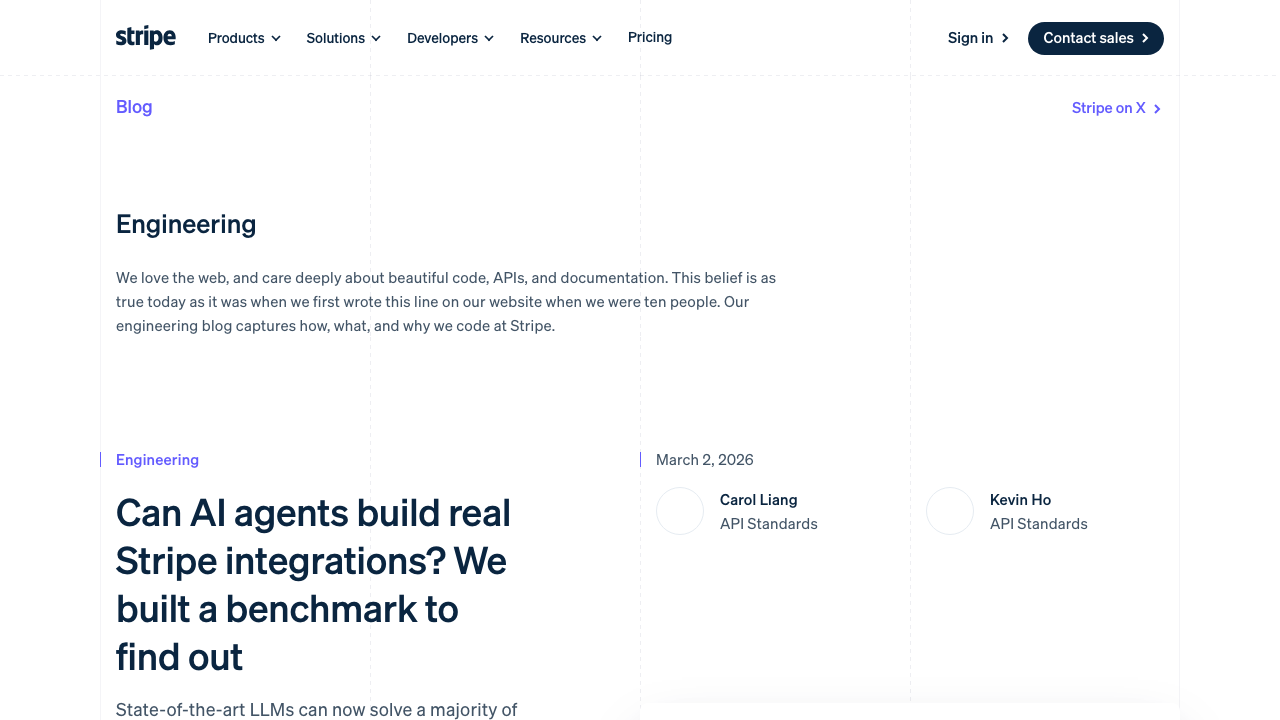
Stripe says it plainly on the engineering blog landing page: the company cares deeply about beautiful code, APIs, and documentation. Plenty of companies could write that line.
Stripe earned it by treating the surrounding content system as part of the developer experience.
Look at the shape of Stripe’s content surface:
- the main engineering blog
- the Stripe.dev blog for implementation guidance
- a detailed public API changelog
- product docs that feel like an application
Each surface serves a different stage of developer trust. The engineering blog proves depth.
The dev blog helps builders ship. The docs close the loop during implementation.
The changelog signals stability and respect for existing integrations.
Moats come from tight fit between content and product friction. Stripe’s fit is unusually strong because payment integrations carry real business risk.
A developer wiring up subscription billing for the first time is not looking for inspiration. They want to know what happens when a card gets declined mid-renewal, and they want fewer mistakes when money is moving.
Stripe teaches the domain, not only the product
Michelle Bu’s piece on the first ten years of Stripe’s payments APIs is the clearest example of why the blog compounds. That article does more than introduce PaymentIntents.
It teaches developers a mental model for why payment methods differ, why asynchronous finalization matters, why state machines matter, and how earlier abstractions created failure modes. Readers leave with a better understanding of payments as a system, not just Stripe as a vendor.
Domain teaching changes the competitive frame. A company that explains the problem better often gets to define the solution space.
Stripe’s posts do that repeatedly. A developer who learns the shape of payment complexity from Stripe starts making decisions in Stripe’s vocabulary.
One detail from that API design piece still stands out to me. Stripe explains that rolling out the new payments API took almost two years, and that the work that dominated was not code or design but migration and developer perception.
Admitting publicly that the engineering was the smaller problem is an unusually honest framing. Honesty is part of the moat because it makes the reader trust the rest of the guidance more.
When a vendor tells me where their own project got slow and ugly, I read their happy-path examples with less suspicion.
Docs, blog, and tooling reinforce each other
A blog post on its own is easy to copy. A content system tied to docs and tooling is harder.
Stripe’s Markdoc post shows why. Wanting product docs to feel like an application while keeping authoring manageable for writers, Stripe built Markdoc to add interactive samples, tailored content, conditional blocks, and reusable structure without turning every doc page into a custom app.
A writer can drop in a snippet that renders the curl example, the Node example, and the Python example from one source, so the page that teaches stays the page that ships. That investment made the docs more useful and made the writing system more scalable.
Moat logic shows up here in a specific way:
- Better tooling makes better docs possible.
- Better docs make blog posts more actionable.
- Better blog posts send readers back into the product with more confidence.
- Better product understanding makes adoption stickier.
Stripe’s public changelog strengthens the same loop. Developers can inspect dated changes, breaking updates, and product-level evolution in a consistent public record.
A team pinning an API version can see what changed between releases instead of discovering it during an incident. That kind of changelog reduces the fear that usually comes with depending on a fast-moving API vendor.
I argued in my changelog post that changelogs are a trust instrument. Stripe proves the point at scale.
The archive itself becomes distribution
Stripe’s dev blog now spans a wide spread of topics, from payments and billing to sandboxes, Workbench, AWS integration patterns, developer productivity, AI agents, and release channels. That breadth matters because it gives Stripe many entry points into search and discovery without diluting the core audience.
A founder searching for “Stripe API upgrades,” an engineer searching for webhook debugging, and a platform team searching for sandbox strategy can all enter through different posts and land inside the same ecosystem. The archive behaves like distributed product onboarding, where the side door a reader stumbled through still drops them into the same building and where choosing the right subreddit for a developer product means finding an existing conversation that gives the product a useful way in.
One reason I think Stripe’s blog became a moat is that the archive keeps widening the company’s right to answer adjacent questions. Stripe no longer only answers “how do I take payments?”
It answers “how do I test, observe, version, reconcile, debug, and scale a financial workflow?” The search and trust footprint grows with every new question the archive can credibly answer.
The 2025 annual letter gives useful scale context here too. Stripe says businesses on Stripe generated $1.9 trillion in 2025, equivalent to 1.6% of global GDP.
Scale alone does not create a moat. Scale paired with credible public explanation does, because it lets Stripe publish insights that smaller competitors cannot easily match.
Public explanation turns that scale into persuasion.
Good technical blogs reduce perceived integration risk
Developers rarely say “I chose vendor X because the blog was good.” They say things like:
- documentation looked solid
- migration path seemed safe
- examples matched my stack
- the company seemed to understand edge cases
- I trusted them more
That is exactly how a moat works. It changes perceived risk before a formal evaluation spreadsheet appears.
Where Stripe’s blog earns its keep is the anxious middle of implementation. The posts about avoiding silent errors, preparing for API upgrades, testing subscriptions, using sandboxes, and debugging with Workbench all target a specific fear: “What happens when the integration gets messy?”
Picture an engineer whose webhook fired twice and double-charged a customer, searching for the exact symptom during an incident. A company that shows up reliably in that moment earns more than traffic.
It earns default consideration.
I covered a similar dynamic in agent harnesses. Teams trust systems that make failure legible and recoverable.
Stripe’s content does that for payment integrations, the way a good flight manual spends more pages on what to do when an engine fails than on cruising altitude. Posts do not just celebrate capability.
They explain failure modes, migration costs, debugging paths, and state transitions.
Documentation creates defensive depth after acquisition
Acquisition is only the first job. Documentation becomes defensive depth when it helps an existing customer absorb change without reopening the vendor decision.
Stripe's API upgrade guidance does that work. A team facing an API change can see the migration path, test against a pinned version, and plan the change before an incident forces it.
That lowers the operational risk of staying with the product. The guide earns its defensive value when a customer can handle change without spending the same afternoon evaluating a replacement.
Quality signals matter more than polished brand voice
Stripe’s moat did not come from sounding polished. Plenty of polished company blogs go nowhere.
Stripe’s edge comes from repeated high-signal choices:
- articles written by people close to the problem
- concrete numbers when numbers matter
- product and domain depth in the same piece
- obvious links into docs and implementation paths
- a public archive that stays useful over time
Stripe also avoids a common technical-marketing trap: a “best practices” post that is only an SEO wrapper for product mentions.
Stripe’s better posts function independently as explanations. Product fit shows up naturally because the company actually owns the problem space it is describing.
All of that is also why this kind of work is difficult to replicate. A real moat comes from the combination of product maturity, internal expertise, editorial judgment, and systems for keeping the work consistent.
Authoritative content does not get you there on its own.
What other companies get wrong when they copy the format
Teams often copy the visible surface of Stripe’s blog and miss the machinery underneath.
Separating content from product truth causes more damage. A content team can meet its publishing schedule even as tutorials drift behind API changes.
Stripe's strongest posts work because their authors can explain state transitions, migrations, and failure modes from inside the problem. Editorial polish cannot recover details that the publishing process never collected.
That separation also costs the team building the product. The analysis of documentation and engineering velocity explains what maintained knowledge changes inside engineering work.
Long engineering posts go up without a docs system worth linking to, so a reader who gets excited has nowhere to land. Architecture stories that impress peers at conferences do little for the buyer or the implementer trying to ship next week.
When product marketing owns every topic, the result reads flattened and evasive, the kind of post that names a problem and then quietly pivots to a feature. And treating the technical blog as top-of-funnel content only means nobody ever asks the question that matters: do these posts reduce integration friction?
A sharper question would be this. Does the blog make the product easier to trust, easier to adopt, and harder to displace?
Stripe’s blog does. That is why I call it a moat.
What I would steal from Stripe
Helping a developer tools or infrastructure company build this kind of moat, I would steal five things from Stripe’s playbook:
- Teach the domain, not only the feature.
- Connect posts tightly to docs, changelogs, and product workflows.
- Publish migration and debugging content, not just launch content.
- Build a reusable authoring system so quality scales.
- Keep the archive discoverable across many high-intent entry points.
That combination is part of the writing work I do for technical companies. Strong technical content should not sit outside the product strategy.
It should change how the market understands the problem and make the product feel easier to choose. My work page is built around that exact outcome.
AI products change what this publishing system must explain because outputs can vary and evidence can go stale between runs. The guide to technical writing for AI products covers those product-specific requirements.
FAQ
Why call a technical blog a moat instead of a marketing channel?
Because a moat changes competitive position over time. Stripe’s blog keeps lowering trust and learning barriers for new developers while reinforcing retention for existing ones.
That is more durable than a normal campaign channel.
Could another payments company copy Stripe’s approach?
They could copy the format. Copying the effect is harder.
Stripe’s results come from the fit between domain complexity, product depth, docs infrastructure, and years of consistent publishing.
What makes Stripe’s technical writing unusually effective?
Posts tend to teach the underlying problem, show real implementation tradeoffs, and connect naturally into product docs and tools. Readers get education and a path to action in the same session.
Does the engineering blog matter if the docs are already strong?
Yes. Docs help during integration.
Blog posts create trust and mental models before integration starts. They also expand search reach into adjacent topics where docs alone would not rank or persuade as well.
What is the biggest lesson for developer-first companies?
Treat technical content as product infrastructure. Once the blog, docs, changelog, and tooling reinforce each other, the content starts compounding instead of resetting every quarter.